
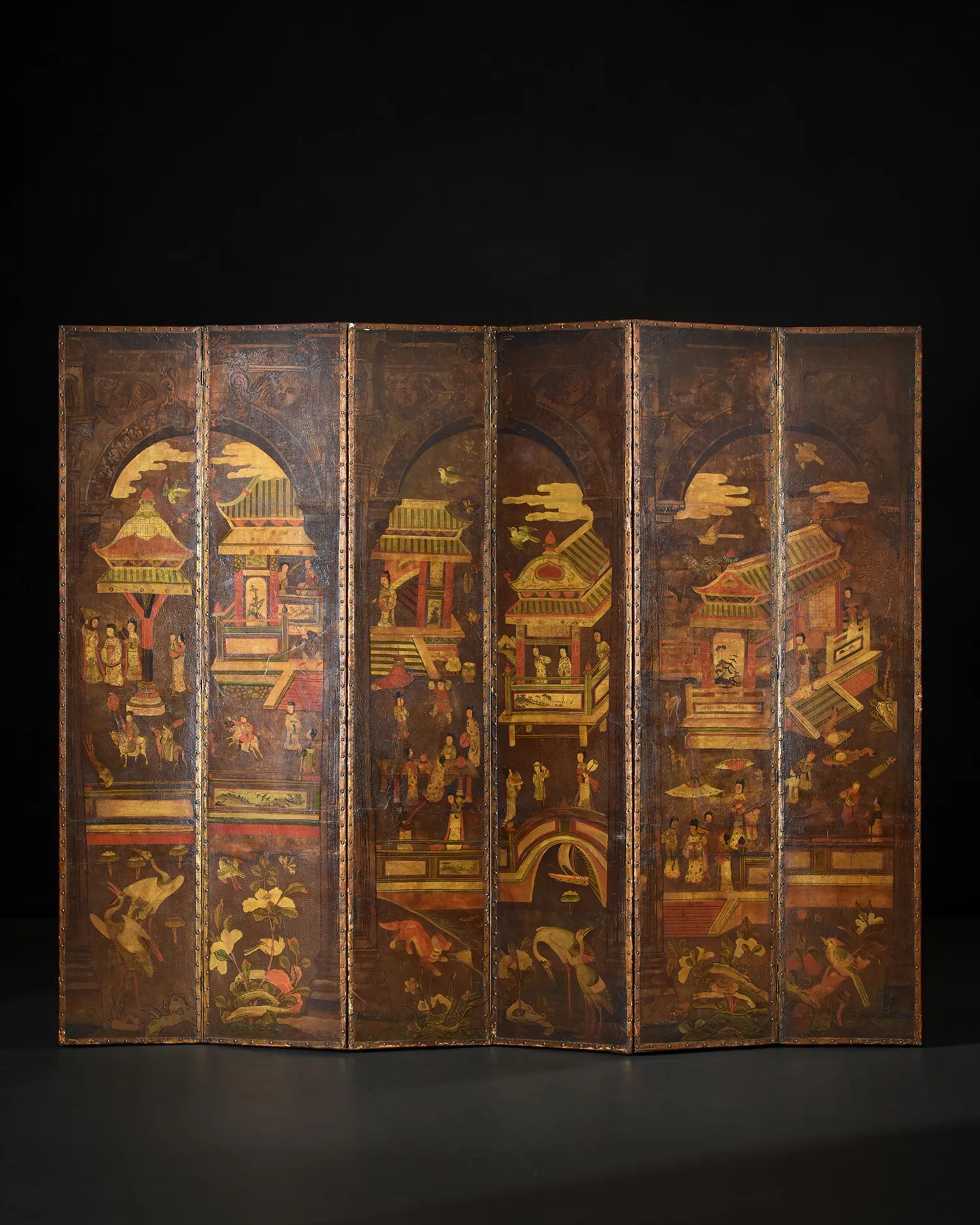
Decorated with painted and gilt chinoiserie scenes on leather, the continuous composition depicts a fanciful architectural landscape populated by figures, pavilions, bridges, birds, and flowering plants, all rendered in rich tones of gold, red, olive, and umber against a deep dark ground. The repeating arcade running across the top of the screen is a rare feature that ties the composition together across all six panels and reinforces its architectural character. The imagery beneath the arcade creates a striking sense of scale and continuity.
Executed on leather and secured with hand-driven tacks to narrow wooden frames, the screen reflects the fascination with imported Asian lacquer and chinoiserie decoration that flourished in England during the early eighteenth century. Painted and gilt leather was employed in a variety of decorative applications, including folding screens, wall hangings, and wall coverings. The apparent use of multiple joined leather sections and the unusually expansive composition suggest a decorative scheme conceived on an architectural scale. The layered roofs, elevated pavilions, stairways, terraces, and bridges are characteristic of the imaginative European interpretations of Chinese architecture that became highly fashionable during the William & Mary and early Georgian periods.
While folding screens served a practical purpose, examples of this scale and ambition were also important decorative statements within fashionable interiors. The combination of painted leather, extensive gilding, and an unusually sophisticated architectural composition distinguishes this screen from the more commonly encountered lacquered examples of the period. The unusually large scale and continuous scenic arrangement reinforce the sense of an architectural landscape extending across the full width of the screen. As the panels are folded and viewed from different angles, the composition continually shifts, revealing new relationships between architecture, landscape, and figure groups.
The screen appears in a period Stair & Andrew advertisement, likely dating from the 1930s. Stair & Andrew, predecessor to Stair & Company, maintained offices at 25 Soho Square, London, and 45 East 57th Street, New York. The firm’s inclusion of the screen in its advertising demonstrates that it was already considered a significant example by the early twentieth century.