
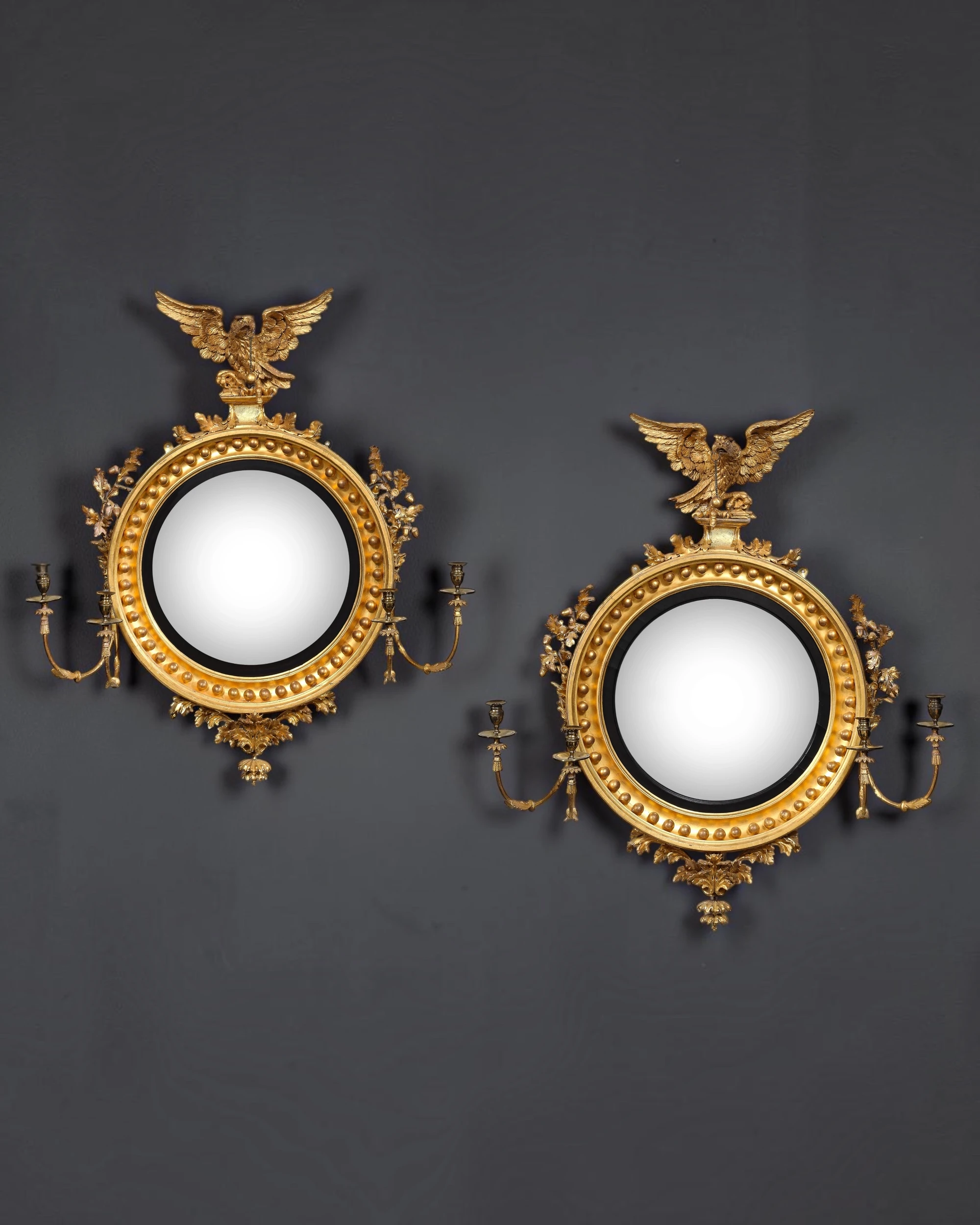
The use of the eagle crest, oak leaf ornament, and naval chain-shot reflects the enduring fascination during the Regency period with maritime power, imperial imagery, and classical symbolism in the years surrounding the defeat of Napoleon. Oak leaves and acorns carried strong associations with England and the Royal Navy, while the chain-shot motif evokes naval warfare and Britain’s dominance at sea during the early nineteenth century.
Convex mirrors were especially admired during the Regency period for the distinctive quality of their reflections. Colloquially known as “bull’s-eye” mirrors, they provided unusually wide fields of view and amplified candlelight in a manner that brought warmth, movement, and theatricality to an interior. Their expansive reflections also allowed activity within a room to be observed discreetly from a distance, adding both practical and social appeal. Thomas Sheraton noted in 1803 that convex mirrors had become “universally in fashion,”¹ admired both for their decorative qualities and their ability to dramatically animate surrounding interiors.
The mirrors constitute a true pair, with the eagles facing in opposing directions. The deeply carved wings and chain-shot borders are particularly well defined, creating strong contrast across the gilded surfaces.
Convex mirrors always have a story to tell, whether it’s in their scale or in the symbolism of the decoration. They always seem to be saying something—military might, social status, contemporary taste. And of course, there’s nothing more romantic than the light cast by convex glass.
REFERENCE
The Metropolitan Museum of Art, The Met Collection, “The Cabinet Dictionary, containing An Explanation of all the Terms used in the Cabinet, Chair and Upholstery Branches,” object no. 52.519.26 (accessed July 29, 2026).
BADA, “Regency Carved Giltwood and Ebony Convex Mirror with Griffin Crest” (accessed July 29, 2026).
LITERATURE
¹ T. Sheraton, The Cabinet Dictionary, 1803, p. 271.