
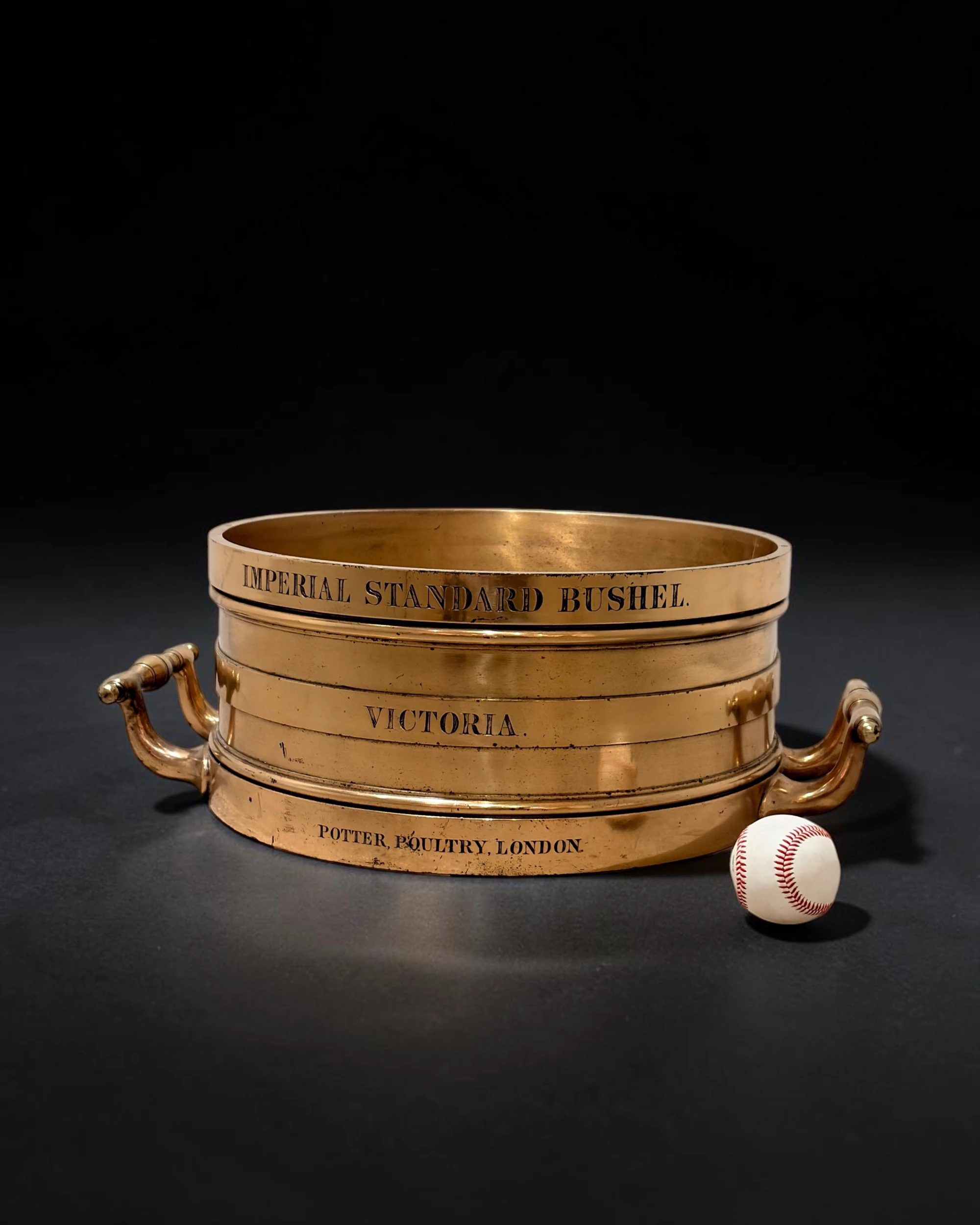
Made for the Colony of Victoria, Australia, by John Dennett Potter, an established London maker of mathematical and scientific instruments, this substantial bell-metal measure is of cylindrical form, with horizontal mouldings and a pair of projecting handles. The exterior is engraved IMPERIAL STANDARD BUSHEL, VICTORIA, and POTTER, POULTRY, LONDON. The measure also bears numerous official verification stamps, including a crowned STANDARD mark and dated inspections beginning in 1867.
The measure represents the standard capacity of eight Imperial gallons. Intended for the official verification of measures used in commerce, it provided a reference against which local inspectors could check the capacity of vessels used by merchants and shopkeepers to sell grain and other dry produce. Unlike measures used in everyday trade, this was an official standard intended to ensure that quantities sold by volume were accurate.
Unlike brass, which is an alloy of copper and zinc, bell metal is a form of bronze containing a relatively high proportion of tin. Named for its traditional use in casting bells, it is harder than ordinary brass and was well suited to an official measure intended to withstand repeated handling.
Following Victoria’s Weights and Measures Act of 1862, standard measures were distributed to local authorities, with a formal system of inspection established in 1864. An apparently identical bushel by Potter survives in the collection of the Buninyong & District Historical Society, Victoria, together with corresponding half-bushel and peck measures. The museum examples bear inspection stamps dating from 1863 to 1916.
“…and a hug around the neck.”
REFERENCE
Buninyong & District Historical Society, Victorian Collections, “Imperial Standard Volume Measures,” collection no. 03240 (accessed 1 November 2026).
C. Ricketts, with J. Douglas, Marks and Marking of Weights and Measures of the British Isles, 1996, p. 47.