
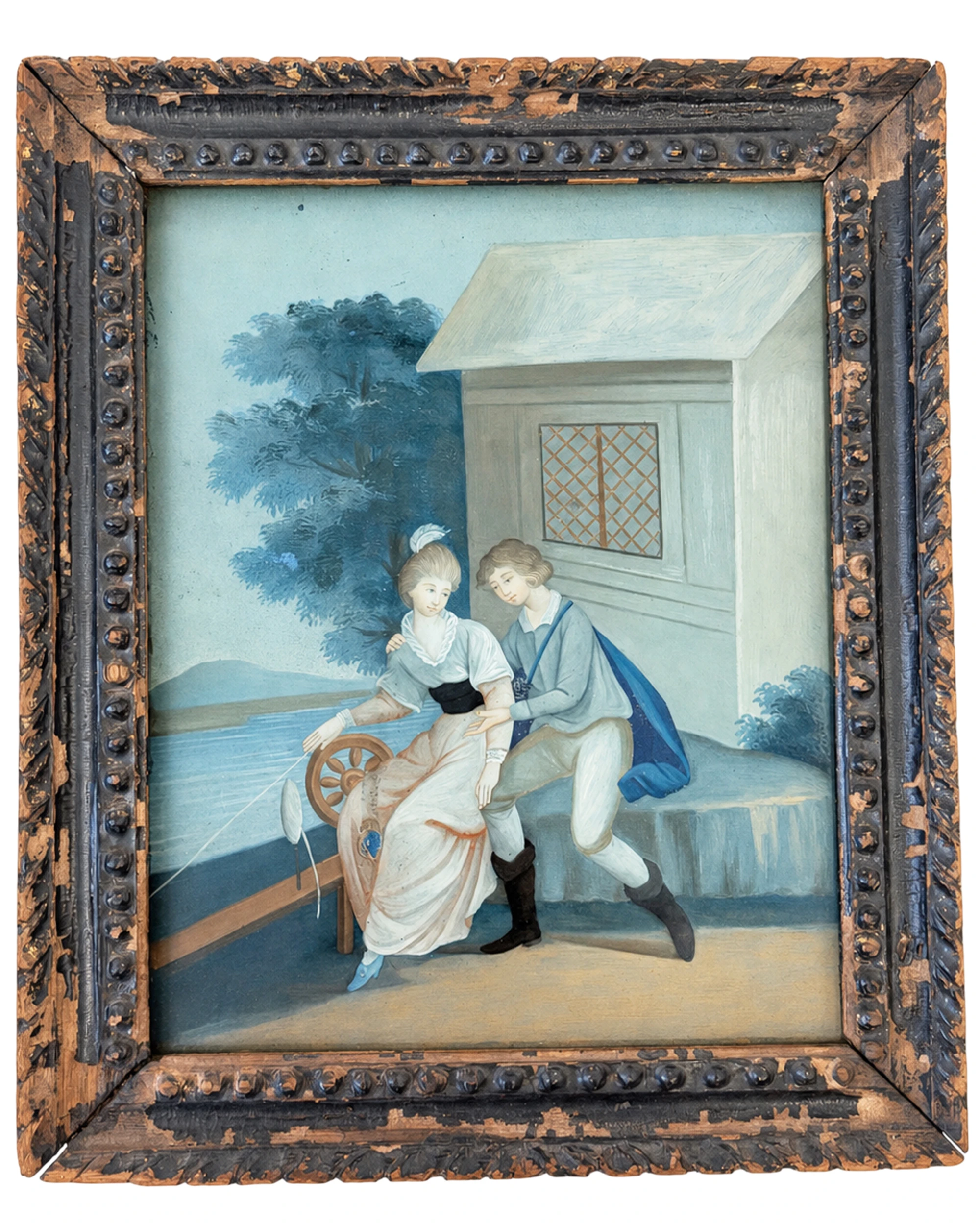
Reverse-painted glass; original matching carved and lacquered wood frames
The compositions depict English domestic subjects adapted from European print sources. In one, a young couple sits outside a cottage, the woman resting her hand on a spinning wheel as her companion embraces her shoulder. The composition closely follows a stipple engraving made in 1783 by Peltro William Tomkins after Sylvester Harding and published in London by Thomas Macklin; a scratched-letter impression before the title is preserved in the British Museum.¹
The companion scene depicts a seated young woman holding a distaff, attended by an older woman, while a man looks from a cottage window and two doves feed beside the water. The design also appears on later Meissen porcelain.²,³ Specialist research has tentatively connected it with a rare print after Angelica Kauffman, although an impression of the precise source print has not yet been located. A further version of the composition, an oval painting titled Courting Doves and catalogued as after Angelica Kauffman, was offered by Gildings Auctioneers in 2012.⁴
A related Kauffman composition appearing on the Meissen porcelain, Harmony, was engraved by Pietro Bettelini in 1784 and reissued in 1804 under the title Beauty Charm’d by Music. This raises the possibility that the unidentified source for the present scene was similarly reissued around 1804, perhaps under a title associating Industry or weaving with Peace or Love.
The paintings exemplify the international circulation of European imagery through the China trade. Working on the reverse of the glass, the artist applied the foreground details and highlights first and the background last, so that the completed compositions are viewed through the glass.⁵
Both paintings retain their original matching carved and black-lacquered wood frames, enriched with foliate and beaded ornament. They closely correspond to a framing type described by Thierry Audric, who notes that, during the final decades of the eighteenth century and the early nineteenth century, Canton workshops produced frames derived from contemporary European models, frequently incorporating a row of carved “pearls” bordering the glass and plant ornament along the outer edge.⁶ The frames are currently offered in their unrestored condition, with thoughtful conservation planned for each.
PROVENANCE
Private collection, Shepherdstown, West Virginia, United States.
REFERENCE
¹ Source composition for the spinning-wheel scene: British Museum, Prints and Drawings, museum no. 1870,1008.239; Peltro William Tomkins, after Sylvester Harding, published by Thomas Macklin, 1783 (accessed 28 July 2026).
² Comparable imagery for the scene with doves: Invaluable, “A Meissen Porcelain Cobalt-Blue-Ground Cabinet Cup,” lot 1590 (accessed 28 July 2026).
³ Comparable imagery for the scene with doves: Invaluable, “Two Meissen Dark-Blue-Ground Pierced Plates,” lot 477 (accessed 28 July 2026).
⁴ Further comparable imagery for the scene with doves: Gildings Auctioneers, Antiques & Collectables, 11 December 2012, lot 81, an oval painting titled Courting Doves, catalogued as after Angelica Kauffman (accessed 31 July 2026).
LITERATURE
⁵ Victoria and Albert Museum, “An A–Z of Glass,” section “R is for reverse painting,” last updated 17 April 2024 (accessed 28 July 2026).
⁶ T. Audric, Chinese Reverse Glass Painting 1720–1820: An Artistic Meeting between China and the West, 2020, pp. 110–113.